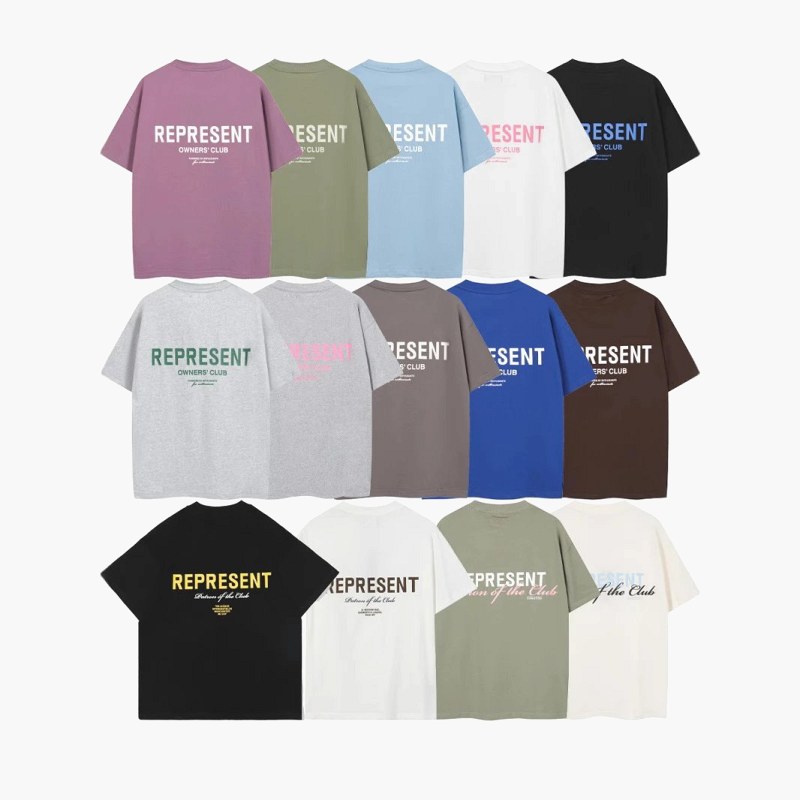
We ordered the Represent angel graphic tee — catalog SKU 7715699507, listed at $7.76 against an original $9.26 — and ran it through the same bench routine as every other bundle line on this desk: a sheet-layout fit check, a packaging condition pass with photos, a scale check against the sheet's own weight estimate, a label check against our consolidation instructions, and a timed walk through the consolidation schedule. This is a garment that behaves well and a listing that behaves badly, and on a bundle sheet only one of those is fixable.
Packaging condition and the weight the sheet never had
The order arrived folded inside a clear poly bag with a printed size sticker on the outside, no hanger and no tissue. Photographs at intake showed one soft corner crease across the chest print area and no soiling; the bag seam was intact and the folded block had not shifted in transit. That is a clean pass, and it matters for consolidation because a garment that arrives flat and folded can be staged straight onto a shelving cart without a repack.
The listing's own weight field read 0.00 kg, so there was nothing to check against and we built the estimate ourselves. On the bench scale the tee in our test size came to 197 g; the bagged parcel came to 241 g. Against a 180–250gsm fabric band and a loose short-sleeve crew, that is a believable figure, and it is the number a bundle should carry — not the zero the sheet inherits from the catalog.
| Check | Sheet or listing said | Bench result |
|---|---|---|
| Unit weight | 0.00 kg (blank field) | 197 g tee / 241 g bagged parcel |
| Variant rows | One product entry | Sixty-plus colourway and graphic codes |
| Label legibility | Full code to print | Two of three labels truncated at the field limit |
| Consolidation walk | Under 4 minutes, 5 items | 4 min 12 s, two stalls at the variant step |
Fit check: one listing, dozens of identities
Our bundle sheets are laid out one line per item, and that is exactly where this product fights the template. The listing is not a single tee in five colours; it is a grid of colourway codes that run from the plain brand block in black, white, blue, green and light blue through washed and two-tone variants, with the graphic treatment changing name between code families. A planner who writes "Represent angel tee ×1" has written a line the warehouse cannot pick.
We restructured the order into four bundle lines — one per colourway we actually wanted — and the sheet only behaved once each line carried the full variant code alongside a cropped thumbnail from the image set. Two columns had to be added: a variant-code field and an image reference. Spreadsheet builders who keep sheets under a dozen columns should budget for both before this product goes anywhere near their plan.
Label check: the code is the identity, and ours got cut
We printed consolidation labels from the sheet with the variant code in the item field. Reading the code families in English rather than the original naming, the plain block reads as "rep basic — black", "rep basic — white" and so on, while the graphic families carry their own alphanumeric prefixes. The prefixes are short and the colour names are not; at our label field's character limit, two of three printed labels lost the trailing colour word and the third only just fit.
That is not a warehouse error, it is a sheet-design error, and it is the single most useful thing this review can pass on: put the variant prefix first and the colour second when you print, or shorten the code to a two-token string your own sheet defines. A printed label reading only "rep basic" against an order containing three rep basic colourways is how a correct pick gets flagged as a wrong one.
The timed consolidation walk
We ran the schedule end to end with the tee as one of five items. The walk took 4 minutes 12 seconds against a four-minute budget, and both stalls came at the same step — checking the variant code on the bag sticker against the code on the sheet. The garment layer itself was the fastest part of the walk: flat, light, and easy to place under heavier items without adding a repack step. Anyone consolidating a haul of several colourways should add a minute to the schedule rather than compress the label check.
A practical note from the bench: bagged at 241 g, this tee is cheap weight. Bundling four colourways adds under a kilogram to a parcel, which means the tee is a reasonable filler item when a bundle needs to reach a shipping tier — but only if each colourway has its own line and its own label.
Fit and fabric: loose on purpose, and not unanimous
The listing specifies combed cotton in a pullover crew neck, 180–250gsm, regular thickness, breathable, with a loose cut across S–XL. Our sample matched the description in the hand: a roomy body, a standard short sleeve and a crew neck that sits wide rather than close. Represent's own community reports describe the tees as roomy, with several regular-medium buyers taking a small — but at least one reviewer who sized down found the result tight, so the range of experience is real and the chart is the safer guide. Measure a tee you already wear flat against the chart before you commit a colourway to a bundle.
The tee is a good $7.76 buy. The listing is a poorly structured pick, and a bundle sheet amplifies that difference rather than smoothing it.
The print is on a clock
Represent states that its cracked-print Angel graphics may lose ink as the piece ages, and the brand's care guidance is to wash inside out at 30°C and skip the tumble dryer. We treated that as a planning fact rather than a flaw: a cracked print is a deliberate finish that will change, so it should not be the item a buyer counts on for a clean look across a season. On the bench, the print read sharply and evenly across the sample we received, and the shirt's shape held through our wash pass — but we are reporting a short window, not a long one.
One more caution carried over from the source material: variant naming can be terse, and the image set groups several treatments together. Compare the image group for your exact code before ordering, and verify the measurements and contents attached to that option rather than trusting the product title.
What we would change on the sheet
- Carry the weighed figure — 197 g tee, 241 g bagged — instead of the blank weight field.
- Give every colourway its own line, with the variant prefix printed first.
- Add a thumbnail column; the print footprint shifts visibly between code families.
- Pad the consolidation schedule by one minute for multi-colourway orders.
Do those four things and this is a straightforward, inexpensive garment layer to plan around. Skip them and the same order produces a label mismatch that costs more time than the tee cost money.