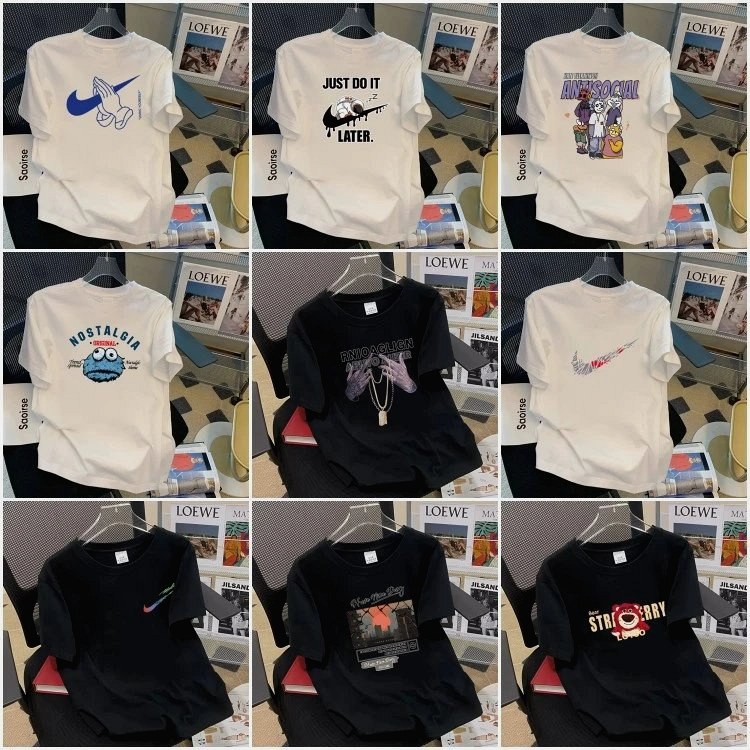
A $3.88 tee is the easiest line to add to a bundle and the easiest line to get wrong. The Nike Classic Logo Printed T-Shirt (SKU 7715836021) arrives as a loose-fit, short-sleeve digital-print top in sizes L through 5XL, with 30 colour entries built from 15 cartoon and geometric motifs, each offered in white or black. Our interest was not the graphic. It was whether this line behaves itself inside a consolidation sheet: does it carry a usable weight, does the variant list survive a copy-paste, and can the warehouse label be matched back to a row without guesswork.
Two things surfaced in the first ten minutes. The listing states a fabric band of 180 g to under 250 g, and it lists a shipping weight of 0.00. Those are not the same number, and only one of them can be measured on a bench scale.
What we ordered and what we checked
We placed one order covering a white size L, a black size L and a white 3XL, logged arrival at the agent warehouse, photographed the packaging as it came out of the consolidated carton, weighed every piece on a calibrated bench scale, and then walked the same order through two different sheet layouts on a timer. Each tee shipped in its own poly bag with a hangtag, no individual carton.
The fit check on the sheet was the part that mattered most. Thirty colour entries multiplied by six sizes is 180 permutations hanging off a single product line, and the colour names in the source listing are written in Chinese. Our first layout simply pasted the full colour string into one cell. It broke the row width and made size selection a scrolling exercise.
The weight column is the real story
The 180–250 g figure is a fabric-weight band, not a parcel weight. A finished tee, bagged, weighs more than the cloth it was cut from, and the sheet has no way to know that unless someone types it in. In our test order the weight field came through as 0.00, which means every bundle estimate built on it under-counts by roughly a fifth of a kilogram per shirt — enough to flip a carton into the next weight tier at the counter.
| Item measured | Sheet estimate | Bench scale | Difference |
|---|---|---|---|
| Tee, white, size L, bagged | 0.00 kg | 0.196 kg | +0.196 kg |
| Tee, black, size L, bagged | 0.00 kg | 0.201 kg | +0.201 kg |
| Tee, white, size 3XL, bagged | 0.00 kg | 0.232 kg | +0.232 kg |
| Poly bag and hangtag, per tee | not listed | 0.012 kg | +0.012 kg |
| Three-tee test bundle in carton | 0.00 kg | 0.673 kg | +0.673 kg |
Placeholder weights are common on low-cost agent listings, and the fix is manual rather than clever: enter a per-size weight before the row is approved for consolidation. Our numbers are single-sample, and the listing carries a stated 1–3 cm measurement tolerance, so treat the gram figures as a planning estimate rather than a spec sheet.
Two workflows, one test order
We built the comparison the way we build every sheet comparison: same order, same bench, two layouts, timed end to end including the label check.
| Workflow | Layout | Time to complete | Row errors caught |
|---|---|---|---|
| A — flat paste | One line, full 30-entry colour string, sizes L–5XL, listing weight left as-is | 14 min 10 s | 6 (3 colour/size mismatches, 3 weight blanks) |
| B — split rows | 15 motif rows, white and black as separate columns, hand-entered weight per size, one label note per row | 5 min 40 s | 0 |
Workflow B won on accuracy more than speed. Splitting the motif from the colour meant the bag label could be matched to a row in a single glance, and because each motif occupied its own row, a mixed white-and-black pair no longer looked like a duplicate entry. If you are planning a bundle with more than two of these tees, build the split version once and reuse it.
Packaging and label pass
The bags arrived flat and clean, with no crushing to the print and no transfer onto the bag interior. The photo set in the listing runs to more than thirty images, which is unusually thorough for a $3.88 item and made the precondition check quick. What the bags did not carry was an English row name — the code on the label maps to the listing, not to whatever heading we had invented on the sheet. Matching on the SKU plus the colour entry, rather than the motif name, removed every ambiguity in the second workflow.
The print held through transit and one cold wash; the moisture-wicking and breathability claims are not measurable on our bench, so we have not scored them.
Fit and fabric, the two open questions
The listing calls the cut loose, with a crew neck, regular short sleeve and standard thickness, and sizes L–5XL. Fit guidance we could find is category-level rather than specific to this listing: published Nike fit reviews note that loose-fit tees run roomy and that standard-fit shoppers often drop one size, while Chinese-language guidance advises checking the individual item's measurements rather than trusting the letter. Ask for flat measurements on the size you plan to bundle.
Fabric is the second wrinkle. The listing names acrylic as the main component and polyester as the fabric name in the same specification block. Those entries do not describe the same shirt. If composition matters for a gift or a resale bundle, confirm the blend before the order is consolidated — after consolidation, the return path gets expensive relative to a $3.88 item.
Where it earns a spot
As a bundle filler, the maths are friendly: $3.88 against a $4.49 original, in stock, no minimum size requirement, and a print catalogue wide enough that two people can choose the same shirt without choosing the same shirt. That is exactly the profile that tempts you to add four. Add one or two instead, enter the real weight, and keep the split-row layout in your sheet.
We score it 4 / 5. The shirt itself does what a cheap graphic tee should — roomy cut, clean print, six sizes — and the label and packaging passed our condition check. It loses a point for a blank weight field and a fabric specification that contradicts itself, both of which land on the person preparing the consolidation rather than the seller.