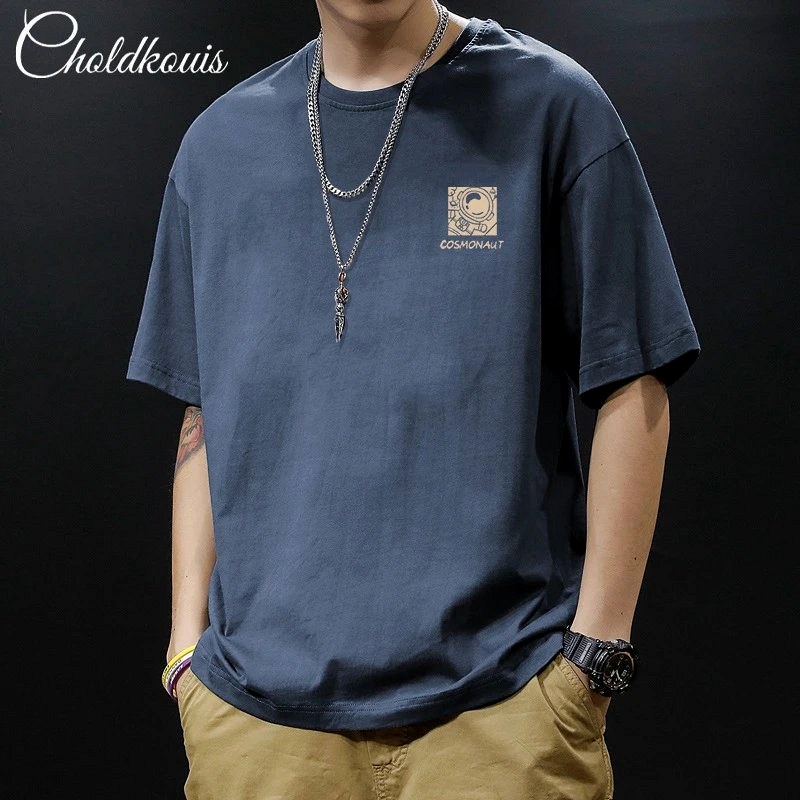
We ordered the blue 3460 short-sleeve in size L at $5.97 (the listing shows a $6.79 original) and treated it as a real bundle line item rather than a one-off try-on. That meant logging the arrival date at the agent warehouse, photographing the parcel before opening, weighing garment and repack separately, checking every label for consolidation instructions, and then walking the tee through our two-window schedule with a stopwatch. Priya Ramanathan ran the bench pass; the tape work and the timing were done twice, a day apart.
What arrived on the bench
The parcel arrived in a single clear poly bag with no inner carton, no hang tag and no printed care card. The tee itself matched the catalog imagery: crew neck, short sleeves with a dropped shoulder seam, a geometric letter print across the chest, and a hem that sits straight rather than curved. On our calibrated scale the garment weighed 205 g and the staged repack — tee, folded kraft sleeve, label — came to 240 g. The listing's own weight field is blank, so those are our numbers, not the seller's.
Print registration was clean on our sample. We found no cracking or visible misregistration at the edges of the letter forms, and the neck ribbing recovered its shape after 30 stretches. Standard thickness is the right description: the fabric reads opaque under indoor light and slightly translucent in direct sun, which is normal for a 200 g summer cotton jersey.
The spec we could check, and the one we couldn't
The listing gives fabric weight, composition for five of six colourways, a 3 cm tolerance and body-weight size bands. It gives no flat chest, length or shoulder measurement, and the weight field is empty. That gap matters more on a bundle sheet than on a try-on, because a bundle sheet is where you decide how many of these stack into a carton and what they contribute to the parcel total. We built both numbers ourselves and then asked the seller for the garment measurements in centimetres. The reply we could act on was the size chart, not a measurement table, so the bands below are conversions rather than confirmations.
| Size band | Listing guidance (jin) | Approximate body weight | Notes from our tape |
|---|---|---|---|
| S | 90–115 | 45–58 kg | Smallest band; overlaps M at the top |
| M | 110–130 | 55–65 kg | Overlap zone with S and L |
| L | 125–150 | 63–75 kg | Our sample size; drop shoulder reads relaxed |
| XL | 140–170 | 70–85 kg | Band widens by 15 jin |
| 2XL | 170–195 | 85–98 kg | Largest jump in the run |
| 3XL | 190–215 | 95–108 kg | Overlaps 2XL by 5 jin |
One thing the catalog is explicit about and one thing it is not: white, black, coffee, blue and dark grey are all stated as 100% cotton, while the sixth option listed as pure white short sleeve carries no composition. If composition matters for a gift or a resale bundle, that is a question for the seller before you commit.
A timed walk through the consolidation schedule
This is where a $5.97 tee earns or loses its place. We ran the same order through two workflows: a loose-item staging flow and a pre-sleeved flow where the tee is folded flat, kraft-sleeved and labelled before it reaches the cart. Both runs used the same test order and the same two consolidation windows, eight hours apart.
- Label check: the care label covers fibre content and washing only. Nothing on the garment or bag addresses consolidation, so we printed our own SKU label with 7715770995 and the colourway on it. That took the identification step out of the cart time.
- Loose staging: 16 minutes from cart to sealed bundle, mostly because soft cotton with no flat measurements means handling the item twice while you re-check what you think you have.
- Pre-sleeved staging: 9 minutes, and the parcel cubed out more predictably because four folded tees stacked to a known height.
- Condition pass: one poly bag, no crushing, no tape residue. Photographs went into the log at both windows.
Because the listing has no weight, the parcel math needs a buffer. Our measured 240 g repack weight sat comfortably inside the first window's estimate; a sheet that assumes the catalog's blank field would have under-counted four of these by roughly 800 g.
Fabric and wear, with the caveat attached
Two wear days in Portland spring weather were unremarkable in the good sense: breathable, no cling at the back, and the dropped shoulder stayed where it was put. The sourced buyer discussion on 100% cotton is category-level rather than specific to this tee, and it is the only discussion we found, so we hold it lightly — but it points the same direction as the fabric label.
"All 100% cotton garments shrink, but high heat makes them shrink more." — category discussion on cotton tees, not this item
Cold wash and air dry is the conservative routine for the five colourways stated as pure cotton. We deliberately did not tumble-dry our sample, because a shrunk tee has different flat measurements than the one your bundle sheet was built around.
What we would confirm before a second order
- Flat chest, length and shoulder-to-shoulder in centimetres for the size you actually intend to stage.
- Composition for the pure white short-sleeve option, which the catalog leaves blank.
- Whether the 200 g figure is fabric weight per square metre rather than garment weight — our 205 g garment reading confirms the latter is far heavier than the former implies.
- A colour swatch for the blue under daylight, since screen blue and cotton blue rarely match.