Most $7.46 shorts never get tested as part of anything. They get bought alone, shipped alone, and judged on whether they look like the photo. We wanted a different question answered: when this pair is one line item inside a five-item consolidation, does it earn its place in the carton, and does it give a bundle sheet enough data to plan around it?
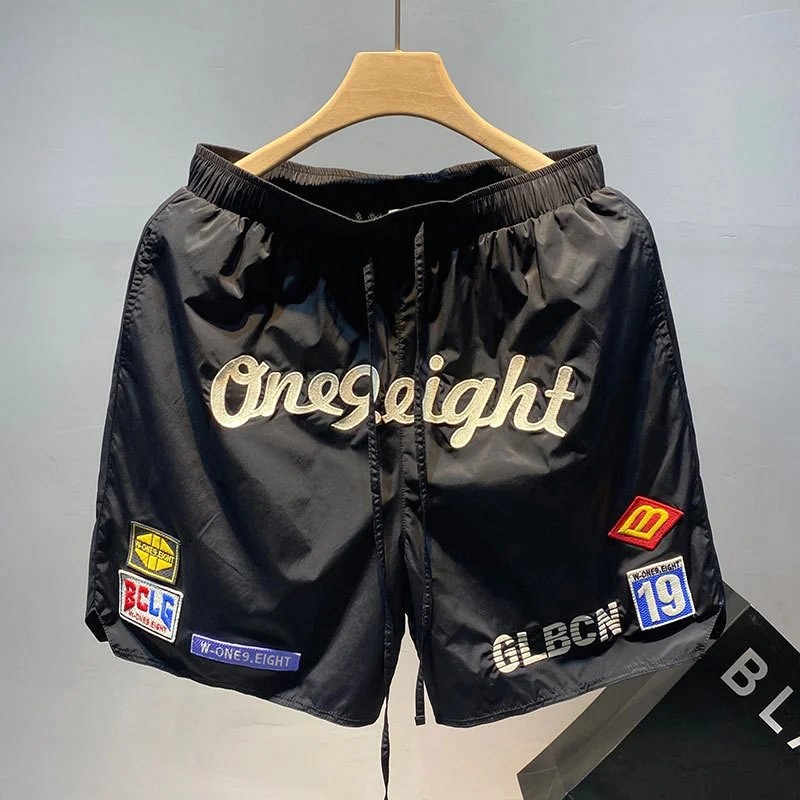
We ordered SKU 7720570468 — listed as Foreign Trade black athletic shorts in sport-casual style — at $7.46, with $8.51 shown struck through. The listing describes a polyester short with slight stretch, a straight leg, a mid-thigh five-point cut, a drawstring waist, script lettering across the front and small patch details on the lower legs, in sizes M to 3XL across white, black, orange and green. We took the black pair in L and put it through the same bench sequence every bundle item gets: fit check on the sheet layout, packaging condition pass with photos, weight check against the sheet's own estimate, label check for consolidation instructions, and a timed walk through the consolidation schedule.
What arrived, and what the packaging pass showed
The pair landed in a plain poly bag, folded flat, no retail box and no hangtag. Photographed on the bench, the finish read as a matte black synthetic with a faint sheen under the lamp, the script print sitting squarely across the front panel and the two lower-leg patches aligned within a few millimetres of each other. Seams at the waistband, side and hem were single-stitched and straight; we found no loose thread ends longer than about 5 mm and no skipped stitches at the crotch bar-tack.
The label check is where the pass slowed down. A consolidation label needs a seller SKU, a confirmed colour and size, a weight, and any handling instruction the packer has to follow. The bag carried a printed size marker and a seller barcode sticker. Inside the waistband there was no fibre or care label to photograph. Nothing on the packaging told a warehouse handler whether to keep the poly bag, remove it, or bag the pair with another item. That is not unusual for factory-source listings, and it is not a defect — but it means the bundle sheet has to carry that instruction instead of the product.
Fit check: four measurements against a blank size chart
The listing publishes no waist, hip or inseam figures, so we took our own on the L pair after two hours of rest on the bench. Garment measured flat, then pulled to the stated slight stretch.
| Measurement (size L, flat) | Relaxed | At stretch |
|---|---|---|
| Waist, drawstring loosened | 33.0 cm | 41.0 cm |
| Front rise | 29.5 cm | 30.0 cm |
| Inseam | 20.0 cm | 20.5 cm |
| Leg opening | 31.5 cm | 33.0 cm |
| Outseam | 48.0 cm | 48.5 cm |
The 20 cm inseam puts the hem clearly above the knee, consistent with the five-point description. The waistband gathered roughly 8 cm on the drawstring before the elastic stopped giving, which is a usable range for anyone between two sizes — but it is a range we measured, not one the seller published. Treat these as one sample's numbers, not a size chart. If you are buying two sizes to hedge, request flat measurements for each before the order closes.
Weight check against the sheet's own estimate
The catalogue weight field for this SKU reads 0.00, which is not an estimate — it is an empty field. Our bench scale put the L pair at 197 g in its poly bag, 179 g out of it. For bundle math, 197 g is the number that matters, because it is the weight the warehouse will see before any repack.
Folded as received, the pair occupies a footprint of about 26 × 18 cm at 2.5 cm thick, compressing to 1.8 cm under a light press. Volumetric weight at the usual divisor lands near 0.2 kg, so actual weight governs — this is a dense, low-volume item, which is exactly what you want filling space beside a bulky jacket or a shoebox. On our sheet we replaced the 0.00 with the measured figure and flagged it as bench-measured rather than seller-supplied.
Timed walk through the consolidation schedule
We ran the same five-item test order through two workflow orders. Workflow A staged and labelled the shorts first, before the bulky items went onto the cart. Workflow B added the shorts last, after the other four items were already weighed and logged. Both runs used the same carton, the same scale and the same sheet.
| Step | Workflow A (shorts first) | Workflow B (shorts last) |
|---|---|---|
| Stage item and open bag | 2 min 10 s | 2 min 40 s |
| Fold, bag and mark bundle ID | 1 min 35 s | 1 min 50 s |
| Weigh, log, apply label | 1 min 05 s | 1 min 20 s |
| Reconcile against the sheet | 3 min 20 s | 5 min 05 s |
| Total | 8 min 10 s | 10 min 55 s |
The gap sits almost entirely in reconciliation. When the shorts were logged first, their weight and footprint were on the sheet before the bulky items arrived, so the parcel total could be checked once at the end. Logged last, the pair forced a second pass over four already-closed lines because the carton total had moved by 197 g. On a five-item bundle that is under three minutes. On a twenty-line bundle, the same ordering habit is the difference between one reconciliation and several.
Bench note, day two: the pair we labelled first cost 8 minutes end to end. The pair we labelled last cost 11. Same shorts, same scale, same sheet — the schedule did the work.
How the $7.46 behaves in the bundle economics
At 197 g and $7.46, this is a light line item that does not distort a parcel's volumetric profile. It will not rescue a bundle that is already over on volume, and it adds almost nothing in weight. Where it earns its place is as a low-risk add-on: cheap enough that a wrong colour or a hem that sits higher than expected is an annoyance rather than a loss, and neutral enough in black that it pairs with whatever else is in the carton.
Two cautions carried over from the spec sheet. First, the listing identifies the maker as Chensida while the storefront and title say Foreign Trade, and the season fields disagree between 2024 and 2025 — so the pair you receive may not match the sample we measured in colour tone or cut. Second, there are no independent buyer claims on this listing. Everything here is our bench work on one pair, not a durability record. We have no wash history to report on this SKU and did not run a shrink cycle.
What held and what did not
- Held: the measured weight and fold footprint, the seam and print alignment, and the 8 cm of drawstring take-up in the waistband.
- Held: the price-to-utility case. As a warm-weather base layer or a cheap line item in a consolidation, $7.46 buys a real garment rather than padding.
- Did not hold: the paperwork. A blank weight field, no published measurements and no care label inside the waistband mean every planning number comes from your bench, not the listing.
The practical takeaway for a bundle sheet is unglamorous. Order the pair early in the consolidation cycle, weigh it yourself the day it arrives, write the measured figure into the sheet with a note that it is bench-derived, and put the bagging instruction on your own label. Do that and the shorts are a clean, cheap, low-volume line item. Skip it and you are reconciling a 197 g surprise against four other lines at the end of a long packing session.