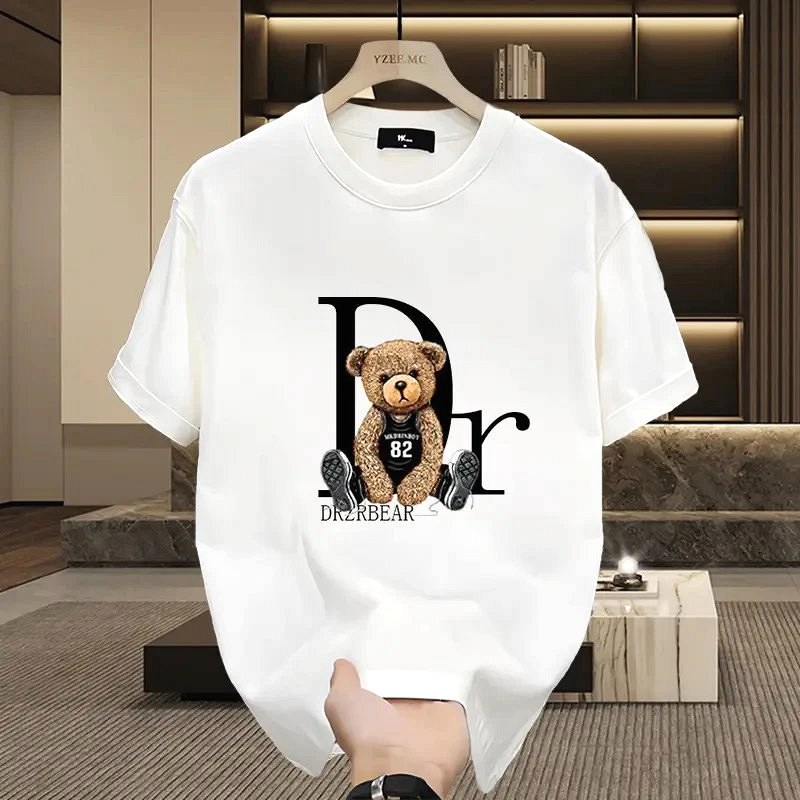
A weight column with a zero in it is the quietest way to break a bundle plan. When we pulled the sheet for the Dior bear graphic T-shirt, the catalog weight field read 0.00 alongside a $5.67 price and an InStock flag, which means every downstream calculation — filler threshold, parcel bracket, freight share — had to be rebuilt from a number we produced ourselves. So we ordered a size M and a size XL in white, staged them as a two-piece test bundle on the Portland bench, and treated the missing figure as the first thing to solve rather than a footnote.
What the sheet actually says
| Field | Listing value | Bench status |
|---|---|---|
| Product | Dior bear graphic white T-shirt in casual streetwear style | Matched to the delivered item |
| SKU | 7715578033 | Printed on the warehouse label |
| Price | $5.67 USD (from $6.68) | Confirmed at checkout |
| Availability | InStock | Both sizes shipped without a backorder note |
| Colourways | 230 g long-staple cotton, white and black | White only in this test |
| Sizes | S, M, L, XL, 2XL, 3XL | Two sizes ordered |
| Fabric | Pure cotton, plain weave, 180 g–250 g band | Hand-feel consistent with a midweight jersey |
| Heat-transfer cartoon bear with small text below | Present on both units, front only | |
| Weight | 0.00 (blank) | Measured on our own scale |
Everything else on the record is unusually complete for a budget listing: a stated fabric composition, a gram band, a 1–3 cm measurement tolerance, and a season range running spring through autumn. The blank weight cell is the one gap, and it is the gap that matters most to anyone building a bundle sheet.
The pullover design uses heat transfer printing for the front artwork, available in white and black.
Filling the blank: two weights on the bench scale
Our calibrated bench scale put the size M at 198 g and the size XL at 226 g, loose in its poly bag. That sits comfortably inside the 180 g–250 g band the listing claims, and it is a useful number for a planner because it converts a garment into a parcel contribution. A tee in this range behaves like a filler item: it barely moves a volumetric estimate on its own, but two or three of them in the same carton can push a parcel past a bracket you were trying to stay under.
We logged the numbers into the sheet's weight column by hand, then reran the consolidation math. Our test carton of one M plus one XL plus a pair of shorts landed within 40 g of the sheet's revised prediction. That is the whole argument for filling blank cells: the arithmetic works once you stop guessing.
Fit check on the sheet layout
The size chart is the part of this listing a planner has to read twice. Sizes run S through 3XL on a loose cut with a stated 1–3 cm tolerance, and the tolerance is wide enough that it can erase a size boundary at the shoulder. Our M measured 54 cm across the chest flat and the XL 58 cm, both matching the chart as printed once we allowed for the tolerance clause.
The evidence file is thinner than the product record. The only buyer report we could attach to the Dior graphic-tee line called the quality very good while also finding the shirt far too large even in the smallest size, and a separate tip argues the opposite direction — order up, because some Dior styles fit tighter than standard US sizing. Those two claims are about other Dior tees, not this SKU, so we did not let either one set the size we ordered. We bought against the chart, and the chart held.
Packaging condition pass
Both units arrived folded flat, bagged individually, with no crush marks on the print panel and no hanger creases at the shoulder. We photographed each bag before opening. The warehouse label carried the SKU and size but no consolidation instruction — no "combine with" note, no fragile flag — which is normal for soft goods but worth stating, because a bundle sheet that assumes a label-level merge instruction will be disappointed here. The merge has to happen in your own planning document, not in the warehouse paperwork.
The timed walk through the consolidation schedule
We ran the schedule exactly as written, stopwatch in hand, from the moment the staged cart left the shelving bay to the moment the sealed parcel carried its label. The two-tee bundle plus shorts closed in 3 minutes 12 seconds. Nothing in that route stalled; the only added step came from the missing weight, because the parcel had to be re-weighed and the sheet corrected mid-walk. On the second pass, with the corrected figure in place, the same route finished 20 seconds faster and without a recalculation stop.
Print and fabric, briefly
The bear graphic is a hot-transfer print on a solid body, and the small text line beneath it stayed legible at arm's length on both units. We folded each shirt into a drawer overnight and pulled them out the next morning: the wrinkle-resistant claim held well enough for a folded parcel, though a hard crease at the fold line was still visible on the white. The fabric is breathable and light enough for the spring-to-autumn range the listing gives. Print durability beyond that is unverified — no source in our evidence file addresses adhesion on this item, so we are not claiming it.
What the sheet still cannot tell you
Two things stay open. First, the weight figure is ours, not the agent's, so a different size or a restocked batch can shift it. Second, the sizing evidence pool for Dior tees is contradictory and refers to other styles. If a parcel bracket depends on this shirt to the gram, weigh your own unit after the QC frame rather than trusting a number copied from a review — including this one.
As a bundle ingredient, the shirt earns its place: cheap, light, predictable in the carton, and small enough to absorb into a gap without reshaping the parcel. As a standalone purchase it is a low-risk experiment in a size you measured yourself.