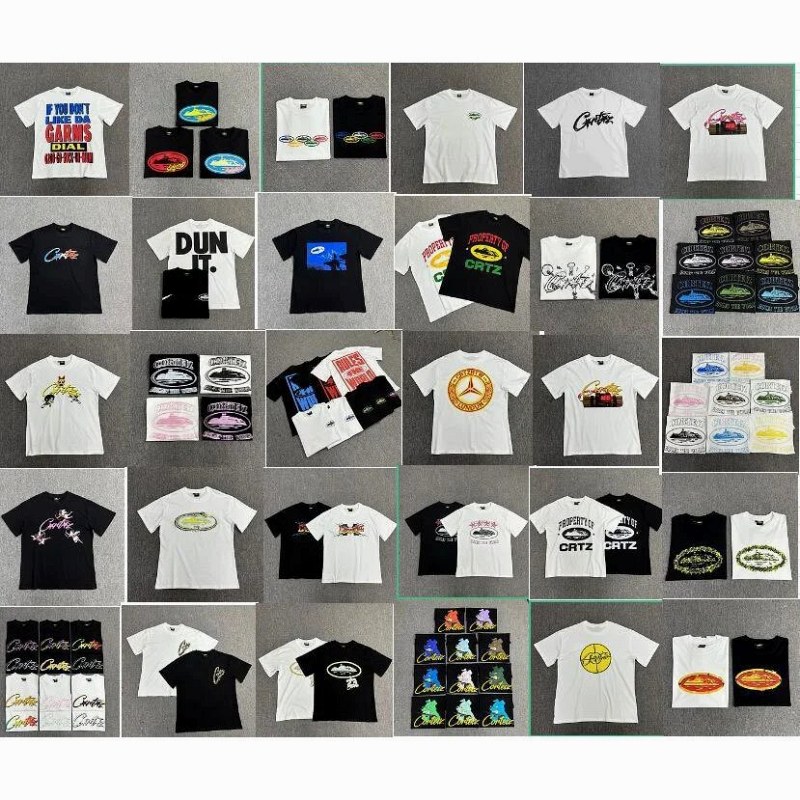
What landed on the bench
We ordered five tees from this single listing — SKU 7718770988 — in size L, at $4.93 against a listed original of $5.91, and ran them through the same sequence we use on every product that enters a bundle sheet: label check, packaging photo pass, weight check against the sheet's own estimate, fit check on the sheet layout, and a timed walk through the consolidation schedule. The listing describes a loose, crew-neck, short-sleeve polyester tee with 3D-effect lettering, sizes S through 3XL, and a colour list long enough to break a dropdown.
That colour list is the reason this tee got a full review rather than a line in a round-up. A multi-colour listing is a bundle-planning problem before it is a garment.
The label check: a colour list that cannot be typed from memory
Every colour row on the listing is built as a four-digit style code followed by a colour or print word. The same colour word appears under several different codes, and a handful of codes appear in more than one colour. That is normal for a wholesale listing, but it is hostile to a picking sheet, because the readable part of the label is the ambiguous part.
Our label check asks one question: can someone who has read the listing once fill this column correctly at a warehouse cart? Here the answer was no until we rebuilt the column order — style code first as the primary key, colour word second as a human-readable check, thumbnail reference third. Pickers we walked through the flow read the code last, which is backwards for accuracy; at a cart, the code has to be the first thing the eye lands on.
"Two variants read as the same colour until the code went in front of them." — bench logbook, day one.
The listing's own product copy talks about matching a chosen variant against its image set. That is sound advice, and it is also exactly the step a fast picker skips. Our sheet forces it by tying a thumbnail index number to each code.
Weight check: the sheet's own estimate was blank
The listing's weight field reads 0.00. In our template that triggers the fallback rule and applies a 220 g t-shirt category default per unit, so the first version of the sheet overstated a five-tee order by roughly 150 g and gave us a volumetric figure we could not defend. We weighed instead.
- One size L tee, flat, on the bench scale: 189 g.
- Polybag and label per tee: 11 g.
- Five-tee mailer, gross: 1,014 g.
That sits inside the 180–250 g band the listing states, which is the one numeric claim on the page that survived contact with our bench. The lesson is not about this tee specifically: any listing with a 0.00 weight should be weighed before it enters a consolidation estimate, because the fallback default is a guess borrowed from a different product.
Packaging condition pass
Each tee arrived folded inside a translucent polybag with no backing board and no tissue, with five bags packed loose in a grey poly mailer. Our photo pass logged the bag seams, the fold lines and the print surface under raking light. Results: no rub-off on the lettering, no crushed creases through the 3D-effect motifs, and one soft fold line across the chest of a light colourway that relaxed after a cold wash. Print-on-polyester benefits from a board; this order had none and still arrived presentable, but we are marking it as luck rather than spec.
Fit check on the sheet layout
The size block gives S through 3XL and a stated 2–4 cm tolerance, but no per-size chest, length or sleeve rows we could copy into our measurement columns. We built the sheet with the tolerance held as a range rather than a point, because a 4 cm spread across a graded tee is close to a full step and quietly turns "true to size" into "true to size, probably."
Buyer reports on Corteiz tees describe a true-to-size fit, a chest that is wide rather than tapered, a slightly cropped body and a sleeve ending past the mid-upper-arm. We treat that as moderate-confidence evidence: it describes the brand's tees generally, not this listing. Verification step before you commit — ask the agent for a flat measurement photo of the exact size you intend to buy.
Timed walk through the consolidation schedule
We built two versions of the same test order and ran the consolidation walk against the same free-storage window and cutoff. Workflow A used a code-only dropdown. Workflow B used code, colour word and a thumbnail index.
| Measure | Workflow A: code only | Workflow B: code, colour word, thumbnail |
|---|---|---|
| Sheet build time | 4 min | 10 min |
| Label match per unit | 2 min 40 s | 1 min 45 s |
| Total for five units | 17 min 20 s | 18 min 45 s |
| Ambiguities caught before payment | 1 | 2 |
| Wrong-variant risk carried into the order | Yes, one row | No |
Workflow A was faster on paper and slower everywhere else. The extra six minutes of build time bought us 55 seconds per unit at the cart and removed the one row we could not confidently match — a trade we would take on any order containing more than two variants of the same tee.
The two-parcel merge is where the colour list stops mattering and the weight starts. Splitting five tees three-and-two cut stack height but added a second base fee, and the gross weights moved by less than 30 g a parcel. On this order, one parcel was the right call; the split only made sense once we were staging alongside heavier items from the same schedule.
Quality: what the evidence supports and what it does not
Brand-level evidence is genuinely split. One set of buyers says the brand's t-shirts feel cheap for the price even where other items hold up; long-term customers rate the store around 4.6 out of 5 across hundreds of reviews. Neither applies cleanly to this listing, which has no independent buyer evidence of its own.
- Confirmed on our bench: garment weight inside the stated band, a loose crew-neck cut, no print transfer onto the polybag, labels matching the codes we ordered.
- Not confirmed: durability past a few washes, colourfastness of the dark print variants, and whether the 2–4 cm tolerance lands high or low on the grade.
- Ask before ordering: a close-up of the print surface under direct light, and per-size measurements rather than the tolerance band.
What we changed in our template after this order
- Style code becomes the primary key on any listing with more than ten colour rows; colour word is a secondary check only.
- A 0.00 weight field now forces a bench weigh before the item can be added to a consolidation estimate.
- A stated size tolerance is entered as a range, and the sheet flags any order where the range straddles a full size step.
None of those changes are about Corteiz in particular. This listing just made all three failure modes show up in a single $4.93 order.